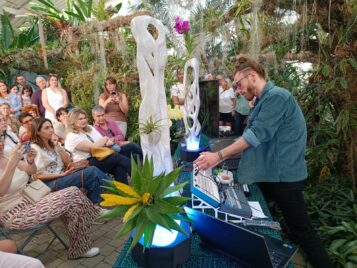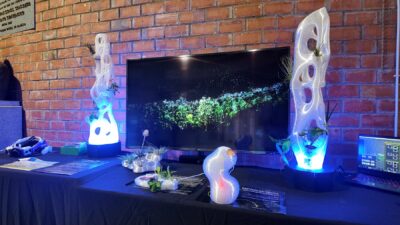

MolinoLab is a space for artistic and cultural creation in the west of the province of Salamanca, in the village of Sancti-Spíritus. The cultural association develops its own projects and organises events and educational activities around the themes that interest us: agroecology, music, dance, digital fabrication, audiovisual creation, self-build and energy self-sufficiency.
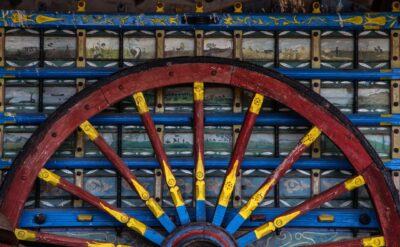
One of our aims for the coming years is to recover and reopen Valeriano’s mill, the museum of traditional agriculture, and turn it into an ecomuseum1.
Two new rooms will be opened in it: the first, on the upper floor, will house current works created for the space, bringing together traditional knowledge and intangible knowledge with artistic and technological innovation. The second will be a space in which to hold activities related to the community (collaborative creation, community radio, digital fabrication, and so on)
We want to invite anyone interested in the knowledge of our elders, in how life was lived not so many years ago in our villages, and to put forward ideas to think about, discuss and work on together.
This community-culture laboratory is carried out in the framework of the Iberian Network of Community Culture Laboratories, which has grants from the Ministry of Culture for cultural projects with a particular social impact and for projects of cultural cooperation in rural areas.
1. A museum centre oriented towards the identity of a territory, based on the participation of its inhabitants, created with the aim of growing the well-being and development of the community
Theme and aims of the laboratory:
The aim of the citizen laboratory is the development of 3 ideas, prototypes, processes, works or research projects related to the themes of the museum (traditional agriculture, popular knowledge, memory, tangible/intangible heritage) and the community.
Who is it for?
This call is aimed at any person or collective that wants to put forward a proposal seeking to reflect on traditional knowledge from a present-day, artistic or cultural perspective, and that is keen to learn and to share knowledge.
Once a maximum of 3 proposals have been selected, a call will be opened to anyone who wants to collaborate in making them a reality. For this, working groups will be formed, made up of the person promoting the idea and the people who collaborate.
What kind of projects can be submitted?
Any proposal that can be designed, built or developed, in a first version or prototype, within a week, and carried out collaboratively, has a place. It may be: a new idea or a process already under way, or the identification of a problem to which a solution is sought. The proposal does not need to be fully defined, since the point is to build it with other people involved.
How to take part?
Proposals may be submitted individually or collectively. Each participant or collective may submit more than one project; it is essential that the ideas presented be open to the participation of other collaborators who can contribute to, complete or transform the proposal during the production workshop.
A maximum of 3 projects that meet the stated criteria will be selected. Once the projects have been selected, a call will be opened to people who want to collaborate in their development.
There are two ways of taking part in the projects:
- As a promoter of a project. By putting forward an idea. If it is a collective, a maximum of two people from that collective may be promoters. Promoters must be of legal age. The organisation reserves the right to fill collaborator places with people from outside the collective to work on that project, in order to foster collaboration among diverse people and the creation of networks of cooperation.
- As a collaborator in the development of one of the selected projects. The maximum number of collaborators per project will be 10.
The groups will have the support and guidance of several people during their development; the groups will have:
- Salomé Méndez Morales of MolinoLab, as artistic adviser on music and the body, as well as mediation with the village.
- Fernando Fernández Sánchez of MolinoLab, as technical and technological adviser and as coordinator of the projects.
- Jesús Molinero, cultural facilitator of Sancti-Spíritus, on mediation with the local population as well as the town council.
Where will it be held?
It will be held in the village of Sancti-Spíritus; some of the activities will take place in the village, others in the MolinoLab spaces, a five-minute walk from the centre of the village.
Calendar:
- Call for ideas. From 16 April to 30 April
- Selection of ideas. From 30 April to 10 May.
- Publication of the selected ideas 11 June, through the website
- Call for collaborators. 11 to 30 June
- Production workshop. 9 to 12 July, from 9:00 to 19:00
- Public sharing: Sunday 12 July
Participants in the workshop will have a space in which to work during the period from 9 to 12 July.
MolinoLab will support those who need it in finding accommodation during those days.
Call for proposals. How to submit a project or an idea?
We invite you to explain what you want to do, with whom and what for, so that we can understand your proposal clearly; fill in the following form.

Decision. Selection committee
The selection committee will be made up of Fernando Fernández Sánchez, Salomé Méndez Morales and Jesús Molinero. It will meet after the close of the call and will study in detail the feasibility of carrying out the proposals, applying the selection criteria set out in the corresponding section of this call.
Assessment of the projects
In the selection of the ideas, the committee will assess:
- Clarity, concreteness and feasibility of the proposal and its fit with the calendar. Bearing in mind that the aim is to have a prototype at the end of the production workshop, the proposal should specify which parts of it can be covered and could have a place during the workshop, and which cannot.
- Originality, usefulness and degree of innovation.
- Technical feasibility. Projects whose technical, time and space requirements are clearly specified and are sustainable in their execution will be assessed positively. If the selection committee has doubts about any technical requirement, it will get in touch with the promoter of the proposal.
- Participation of promoters and collaborators with diverse profiles and skills.
- Making the most of resources, recycled materials and zero waste.
- Sustainability of the project and capacity for replication.
- Diversity of ideas/themes in the selection of the set of proposals.
Publication of the selected projects
The decision will be published on 10 May on the website set up for the citizen laboratory, at https://molinolab.org/en/molino-de-saberes-citizen-laboratory-of-memory-art-and-territory/. It will also be sent by email to all applicants.
Public dissemination of the projects
The prototypes developed will be presented publicly by the promoters and collaborators on the final day of the workshop.
Participants authorise the prototypes and/or their documentation to be published on the organisers’ websites.
Commitments of the organisation
MolinoLab, as organisers of the laboratory, undertake to:
- Provide, as far as possible, the means needed to carry out the selected proposals, contributing the basic equipment and resources for the production of the selected proposals, provided the person putting forward the idea has requested them in advance.
- Make available a space in the MolinoLab facilities or in the village, in places provided by the Sancti-Spíritus town council, for the workshops to be held.
- Support participants in documenting and publishing the results, promoting the dissemination of the knowledge produced during the workshop.
- Make available to the working groups a space in which to house the projects, the documentation and the resulting prototypes.
- Give visibility to the projects on the website and social media
- Offer, within their possibilities, the conditions needed so that no one is limited by reasons of functional diversity or other circumstances.
Commitments of the selected people or collectives
The selected people or collectives undertake to attend the workshop for its full duration, and must be available to communicate with the organisation during the development of the project.
They also undertake to document the projects through the means offered by the organisation, and to share the knowledge developed so that it is available under open licences. They must present the projects developed publicly on the final day of the workshop and make the prototypes available for public exhibition.
The projects received must accept and encourage the participation of people interested in collaborating. The credits of the project will set out the participation of each member of the team and its development in the framework of the workshop.
Participants must take care of the materials, tools, furniture and spaces during the workshop, and maintain a respectful attitude towards everyone.
Authorship and intellectual property
Participants in the call whose proposals are selected must license the creations and the materials derived from them (texts, photographs, videos, etc.) under a Creative Commons licence (Attribution – ShareAlike (BY-SA), which allows derivative works and implies the use of the same type of licence for their distribution).
Contact
Email:
info@molinolab.org
Activity carried out thanks to the support of: