
By MolinoLab
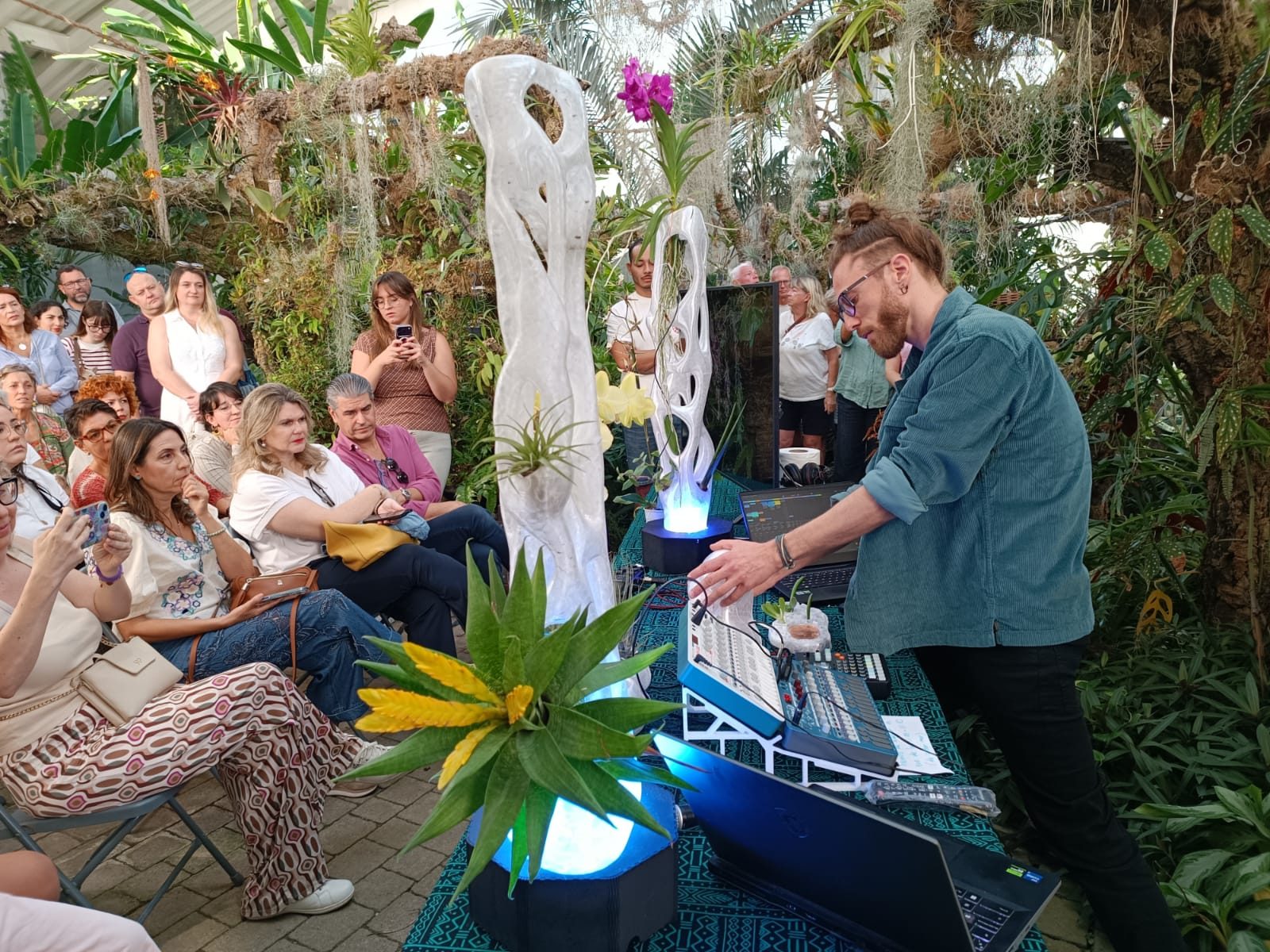
On Sunday 25 October 2026, at 10:00, the Parque Botánico-Orquidario de Estepona gave the leading role to two of its orchids. “Listening to the Invisible”, a work by Sinfonía Biótica developed at MolinoLab, was premiered in the framework of the 11th Orchid and Collectors’ Plant Fair. The press presented it as the first concert with orchids held in Spain. And the work is staying: it is now a permanent installation at the Orchidarium.
What happened
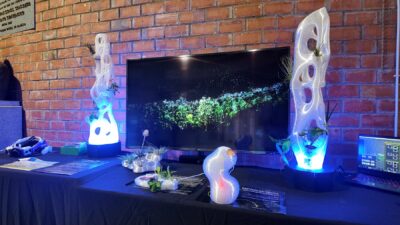
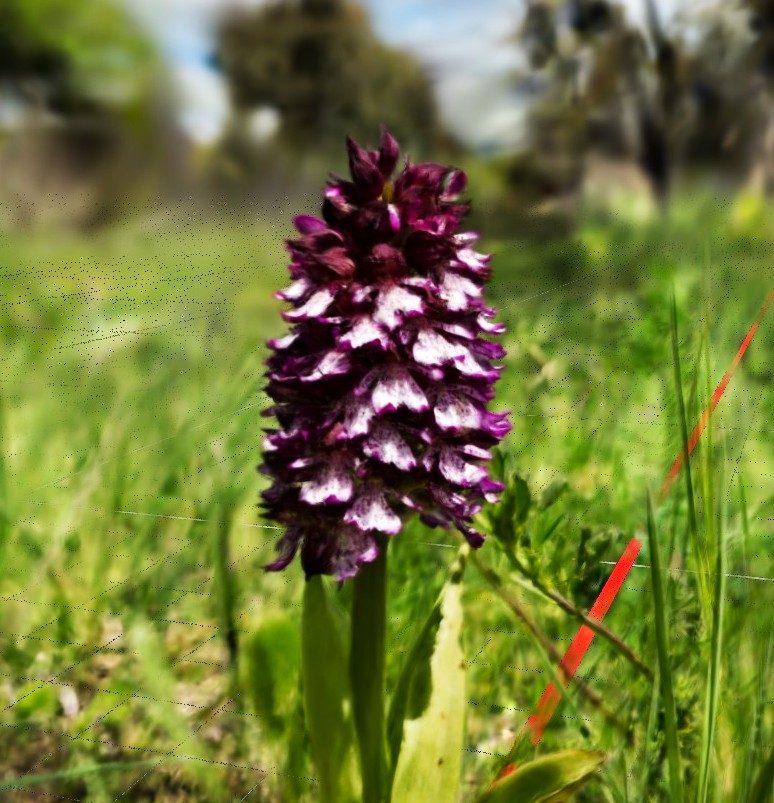
Plants do not sing or speak. But they do generate electrical activity, and with the right sensors it is possible to measure it. For this piece, we connected two living orchids, each to its own biodata unit. The sensors capture the variations in each plant’s bioelectrical signal and send them to an audiovisual engine, which translates them into pitch, dynamics, timbre, density, rhythm and effects.
Each orchid plays its own virtual instrument, so that two “voices” can be distinguished. They are not fixed melodies, but two ways of behaving, in timbre and in dynamics, that answer one another through the space. Together they compose a generative soundtrack that changes constantly and is never repeated in exactly the same way. The spatialisation of the sound was designed for the Orchidarium itself, so that the music forms part of the garden rather than covering it over.
On a central vertical screen, those same signals move particle clouds and animated sequences of digitised orchid species. The image does not show the sensor data literally, but interprets them: the digital twins give them form, and the biodata give them variation and breath.
The experience
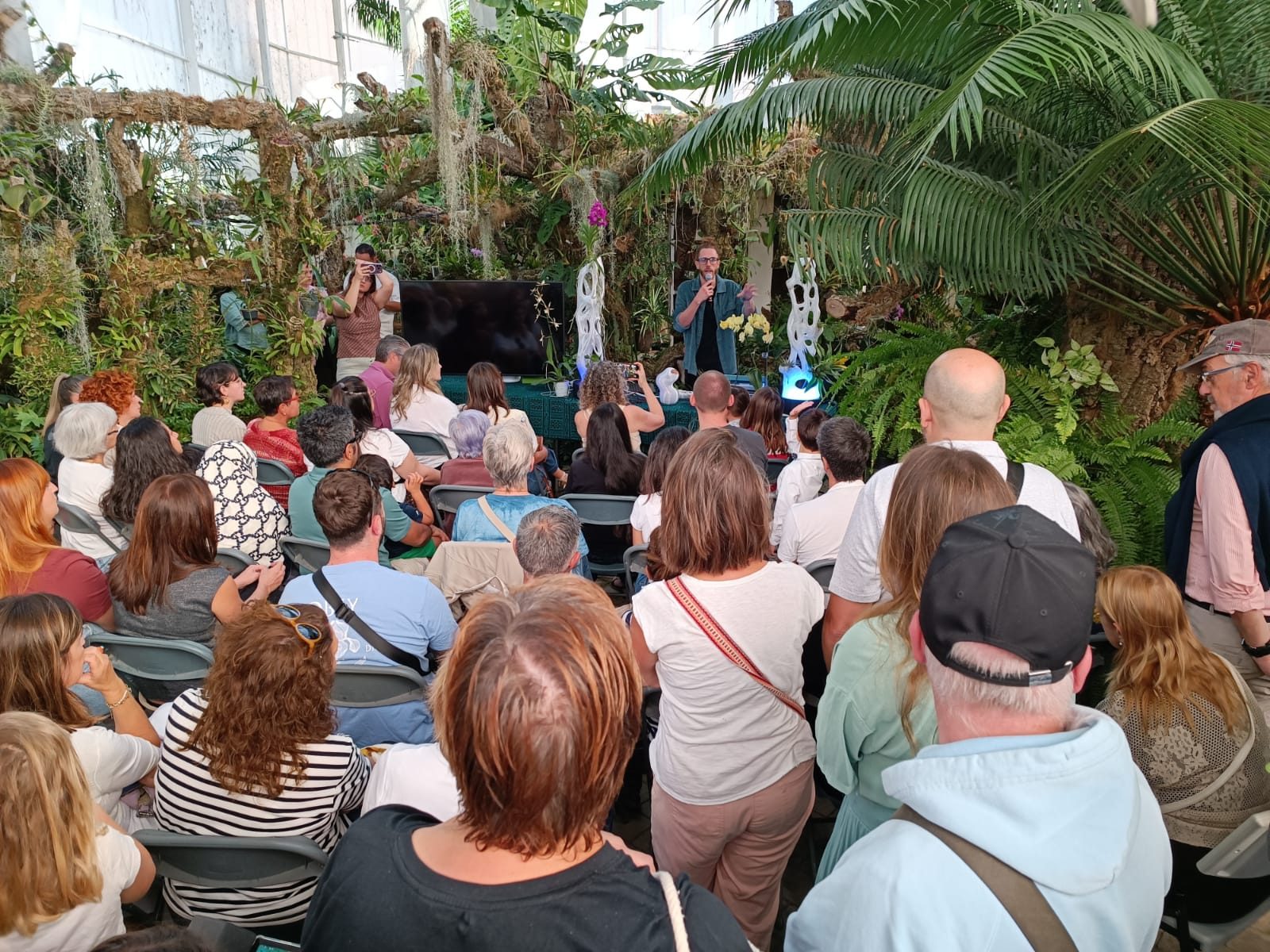
The premiere concert lasted an hour. According to Infobae, it caused a stir among a large group of botany and music enthusiasts, as well as curious people keen to “listen” to the plants. The orchidarium was full: more than a hundred people passed through.
“Plants do not speak or vocalise,” Fernando Fernández explained during the day, “but they do interact with the environment around them and generate a whole series of electrical impulses.” Light, humidity, temperature and even the presence of visitors modify the signal, so that each moment is unique and unrepeatable. The biodata do not attribute thoughts or intentions to the plant. As Fernando told Europa Press, the piece works as “a bridge between biology and aesthetics”, and makes audible a dimension of plant life that usually remains invisible.
Digital twins
The project also includes the 3D digitisation of six selected specimens: scanning, mesh cleaning, optimisation and texturing. Each one is captured at a particular moment of its flowering. These virtual clones feed the visuals of the installation and begin a living archive of the Orchidarium’s flowerings, ready for use on the web, in exhibitions and in education. Over time, more specimens and new virtual instruments will be able to be added.
Credits
- Concept, sound and visual composition, and live performance: Fernando Fernández (@b1tdreamer)
- Production: MolinoLab, a space for artistic experimentation in Sancti-Spíritus (Salamanca), within Sinfonía Biótica
- Hosted by: Parque Botánico-Orquidario de Estepona, Estepona Town Council, in the framework of the 11th Orchid and Collectors’ Plant Fair
In the press
- RTVE (La 1, Telediario): “Orchids to create music”.
- Infobae (25 oct. 2026): An ‘orchestra’ of orchids triumphs with a novel concert that lets you hear their music
- ABC (21 oct. 2026): Estepona makes the orchids sing
- Europa Press (21 oct. 2026): The Estepona Orchidarium will have a pioneering installation in which orchids will create music live
- Diario Sur (21 oct. 2026): The Estepona Orchidarium will turn the biological activity of its plants into live music
- Ayuntamiento de Estepona (21 oct. 2026): Official note
- Orchidarium Estepona (22 oct. 2026): The Estepona Orchidarium presents the first concert with orchids to be held in Spain
- Planomato: The Estepona Orchidarium turns plants into music
- La Gaceta de Salamanca — https://www.lagacetadesalamanca.es/provincia/voz-orquideas-20261102071500-nt_amp.html
- La Gaceta de Salamanca — “The voice of the orchids” (interview with Fernando Fernández)
Watch the reel
Visit
The installation is now a permanent part of the Orchidarium (Calle Terraza, Estepona). Opening hours: Tuesday to Saturday, 10:00 to 13:30 and 15:00 to 18:00; Sundays, 10:00 to 14:00. Closed on Mondays.
Thanks to everyone who came to listen. More information at sinfoniabiotica.xyz and molinolab.org.