
La pasada primavera de 2024 vinieron a tomar muestras de las egagrópilas de las lechuzas que viven en el antiguo transformador eléctrico que hay en la finca, ese que por 1943 empezó a convertir la fuerza del agua en electricidad para la población de Sancti-Spíritus. Esos análisis forman parte de una investigación sobre especies autóctonas y exóticas en fauna terrestre y aves marinas.
Entre los diferentes muestreos que se hacen desde el proyecto, están los análisis de egagrópilas de lechuza. Constituye una herramienta poco invasiva y muy efectiva que nos ofrece información muy valiosa sobre la presencia de micromamíferos en cada zona de muestreo.
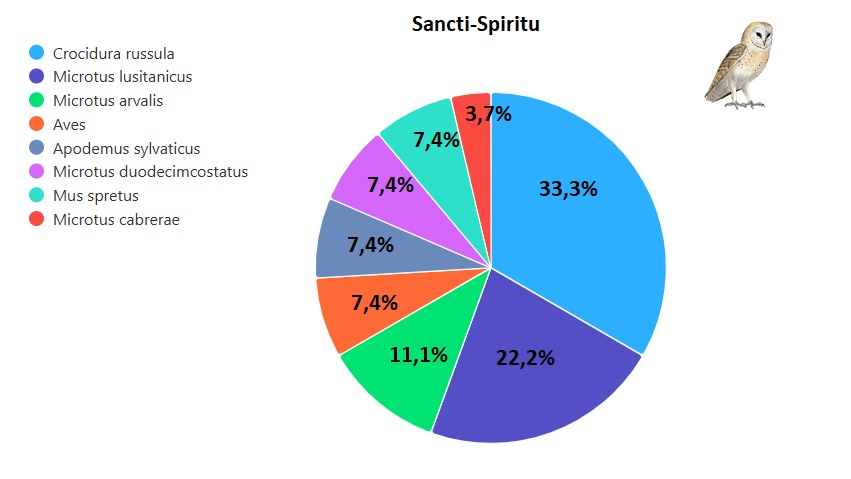
En MolinoLab recogimos las egagrópilas en primavera de este año, se enviaron a la sede de SECEM en Sevilla donde se analizaron. Los cráneos identificados fueron de musaraña gris (Crocidura russula), es una de las musarañas más común, ocupa casi cualquier tipo de hábitat y se alimenta de invertebrados; de topillo lusitánico (Microtus lusitanicus), es un topillo pequeño típico del cuadrante noroccidental de la península, con hábitos subterráneos y exclusivamente herbívoro; de topillo campesino (Microtus arvalis), es un topillo mediano que se distribuye en la mitad norte de la península, con preferencias de zonas abierta con vegetación densa, donde se alimenta específicamente de plantas; de ratón de campo (Apodemus sylvaticus), se puede encontrar en toda la península y Baleares, se adapta casi a cualquier hábitat y se alimenta de los recursos disponibles en cada momento; de topillo mediterráneo (Microtus duodecimcostatus), es un topillo pequeño que se encuentra en toda la península, excepto en el norte, a partir de la Cordillera Cantábrica, prefiere zonas abiertas donde se alimenta exclusivamente de vegetación; de ratón moruno (Mus spretus) con un área de distribución es similar al topillo mediterráneo, en hábitat muy variados, cuya alimentación depende de la disponibilidad de recursos; y de topillo de cabrera (Microtus cabrerae) es un endemismo ibérico, con una distribución muy fragmentada, está en el Catálogo Español de Especies Amenazadas considerada como “vulnerable”, por lo que la población de esta especie en el Campo de Yeltes es muy importante. También se han localizado algunos cráneos de aves, pero no se ha llegado a identificar las especies.
Más información sobre el proyecto
El proyecto MOMAT, está dentro de un gran proyecto “Fauna terrestre y aves marinas (especies autóctonas y exóticas invasoras), mejora de conocimiento del estado de conservación”, es un encargo del MITECO, coordinado por SECEM y gestionado por TRAGSATEC, que tiene como objetivo diseñar un plan de monitorización de mamíferos que está sirviendo para recopilar información de determinadas especies, principalmente las que no son emblemáticas o cinegéticas. También para ayudar a completar los informes de las especies presentes tanto en los anexos de la Directiva Hábitat como en el reglamento comunitario sobre especies exóticas invasoras, y, finalmente, para actualizar el Atlas y Libro Rojo de los Mamíferos Terrestres de España.