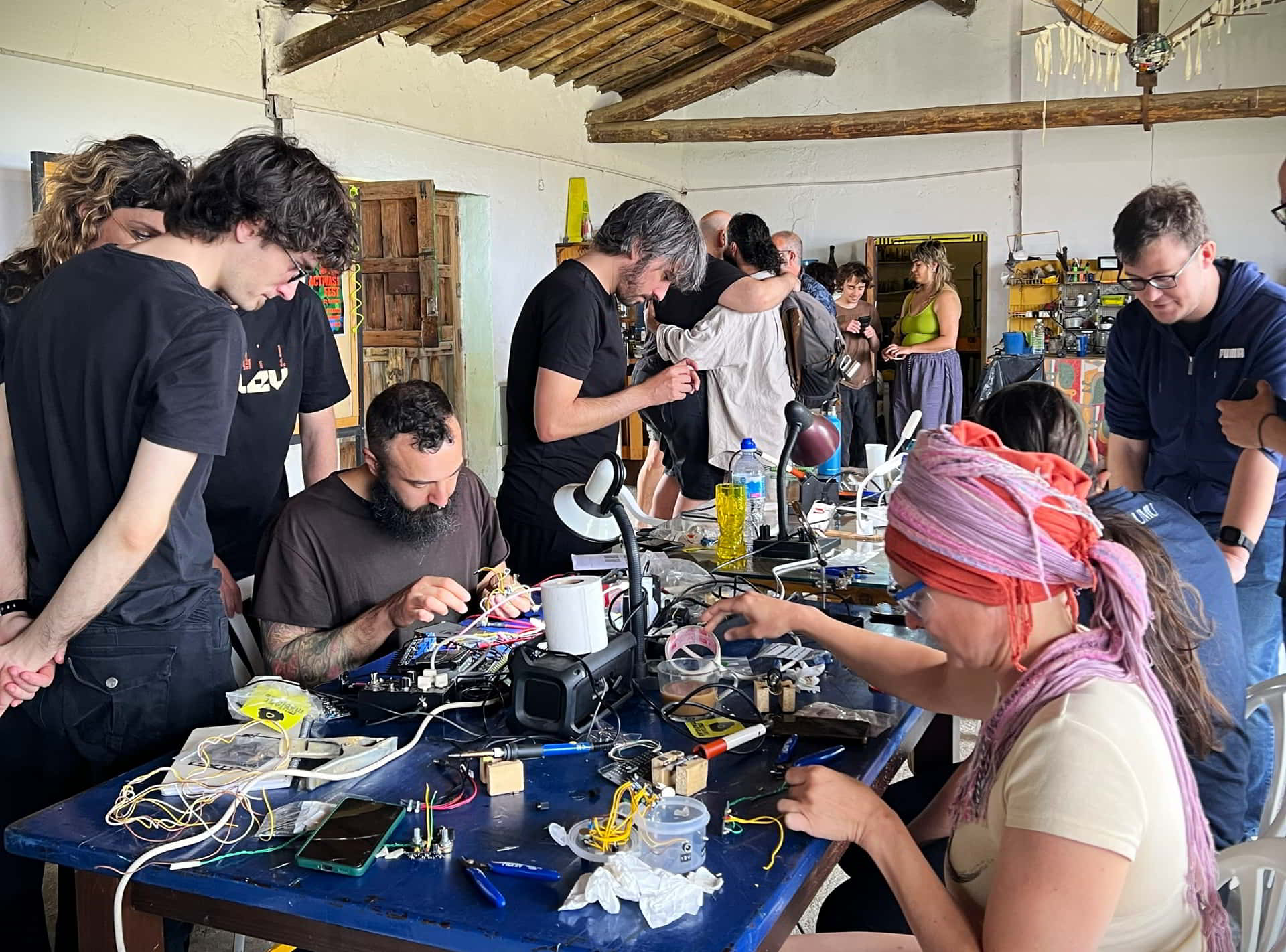
This year, the Iberian Network of Community Culture Laboratories or RILCC selected MolinoLab and our project Molino de Saberes to run a collaborative prototyping laboratory on the ecomuseum we are designing at Valeriano’s mill: Museum of traditional agriculture that Valeriano Sánchez Torres, Fer’s grandfather, created.
Many thanks to everyone who took part, sending and sharing ideas; it has not been easy to assess them and to have to select three. On the grounds of relevance, ease of development and fit with the resources we have, the following have been selected:
An Imperfect Archive – Amarillo 109
It is a prototype of a participatory method for activating musical memory and the transmission of popular knowledge through gathering, play, oral transmission and today’s digital networks of communication and social life.
The project proposes bringing together people of different ages, backgrounds and paths from Sancti-Spíritus to sing, play, dance, remember and reinterpret songs linked to rural life (work songs, celebrations, childhood, care, and so on), creating a space of exchange in which tradition is activated from the present.
As opposed to models of exhaustive documentation, the proposal, through a series of “rules of the game”, sets out the creation of a collective sound archive that is deliberately incomplete, by way of WhatsApp. This archive is built from fragments: partial recordings, voice notes sent days later, transformed or reinterpreted versions, reproducing the real conditions in which oral tradition is transmitted: in a partial, changing way, situated in everyday life.
During the laboratory an intensive prototype of this method will be developed through three participatory gatherings:
- Imagined ritual (memory and collective creation)
- Tired song (memory, body and territory)
- Undisciplined archive (childhood and reinterpretation)
The result will not be a closed record of local folklore, but a living collection of fragments that reflect how songs circulate, are transformed and are reinvented in the community.
The proposal is linked directly to the territory by activating musical knowledge tied to rural life, generating diverse spaces of encounter and exploring contemporary, accessible and replicable ways of building community memory.
Fragile Archives – Benjamín Slavutzky
It is a project that collects domestic cassette tapes in rural territories in order to reactivate forgotten sound memories through collective listening, experimental workshops, a digital archive of the tapes and a participatory sound installation.
The aims are:
- To recover local sound memory by collecting domestic cassette tapes from Sancti-Spíritus (recordings of festivities, work in the fields, radio or conversations) that are at risk of being lost.
- To design and build an interactive sound installation as a community, using recovered cassette players, simple mixing desks and reused materials, also integrating field recordings of the agricultural and natural surroundings of Sancti-Spíritus.
- To generate an open and replicable archive that documents the process and the recovered sounds, under a Creative Commons licence, so that the community can keep expanding it and other rural initiatives can replicate the experience.
The idea would be to put out a call for tape-listening sessions, which would also work as a swap market. In this first contact, we will make a selection of tapes to digitise over the following days. On the third day there could be a workshop on experimenting with tapes. And on the last day, to present the installation made up of different cassette players (I would bring a base, later to be complemented with objects I may find in Salamanca) playing some of the tapes found, field recordings, interviews, and so on.
Threads of Memory – Marisa Raboso
The idea is to take the charro costumes of the older people, the ones they keep so carefully in the chest, and put them in an exhibition to make their value clear, so that young people and people from outside really understand it. Instead of just leaving the mannequins standing there, we will work on an idea to show them in an interactive way, using technology to connect with the people behind those costumes, with their stories. A work of gathering popular knowledge, people’s stories.
It could be, for example, that when you come close to a costume, a light comes on and you hear the voice of our grandmothers telling, in their own words, what they used that apron for, or how heavy the skirt felt on their wedding day.
So that visitors hear their anecdotes and the music the costume was used for. Also large photographs of the silver buttons so that people can see them in detail, with an explanation of their meaning.
In the end, it is about mixing the memories and the gaita and tamboril music of always with modern systems, so that the memory of our village is not lost and young people feel pride in their roots.
MolinoDrumBox – O-Mura
The project explores the transformation of an old mill into a mechanical musical instrument. The proposal consisted in using different elements of the mill itself — wooden structures, metal pieces and other original components — as sound sources, triggering them with solenoids to generate rhythmic patterns.
To do this, we used a prototype able to convert MIDI signals sent from a DAW into pulses (triggers), making it possible to control the solenoids precisely and to sequence the installation as if it were a drum machine.
The installation was completed successfully and culminated in a short live improvisation, combining modular synthesisers with the acoustic sounds of the mill. The result was a dialogue between industrial heritage and contemporary musical technology, in which the architecture of the space became part of the instrument itself.
Call for collaborators
The call for collaborators is open; we are looking for people interested in helping to shape, define and carry out these ideas collaboratively. People who know about traditions, folklore, photography, sound art, technology… A team of collaborators will be formed for each project and on 9, 10, 11 and 12 July we will work with several artistic and technological mentors to create a prototype of that idea. What matters is to learn and enjoy the process. The prototypes will be presented on Sunday 12 July in Sancti-Spíritus.
And now? Is there a project that particularly interests you?
If you would like to come for a few days to take part in the laboratory and learn together, fill in the following form: